A Furry Friend In a Time of Need
RICHMOND, Va. – The room can feel heavy in a hospital psychiatric unit. Conversations are quiet, movements slow. Then a dog walks in, and something shifts.
Patients who were withdrawn begin to engage. Shoulders loosen. Conversations start flowing.
At Virginia Commonwealth University Health, those moments are no longer just anecdotal. Researchers have found that therapy dogs can measurably reduce loneliness among hospitalized psychiatric patients, offering a rare window of relief in clinical settings where the most vulnerable among us reside.
The study, led by Nancy Gee, had patients assigned to one of three groups: a visit with only a handler, a visit with a therapy dog and a handler, or standard care.
“It was the presence of the dog that was associated with, or actually produced, the reduction in loneliness,” Gee said. “The human handler did not.”
That distinction is crucial. While past research has suggested benefits from animal-assisted therapy, many studies have struggled to separate effects of human interaction from the presence of the animal itself. By isolating those variables, Gee was able to show that the dog alone played a central role.
The findings align with what therapy dog handlers and program leaders have observed for years.
Therapy dog visits are typically patient-led, allowing individuals to engage at their own pace, said Taylor Griffin, national director of Animal-Assisted Intervention Advancement at Pet Partners. Some patients respond immediately, while others simply sit nearby, taking in the presence of the dog.
Even those quieter moments, on the surface may seem unproductive, but evidence now tells otherwise.
“In terms of immediate changes, we often see subtle but important shifts. People relax physically, their mood lifts and they may become more communicative,” Griffin said. “Staff sometimes note that patients who were withdrawn or hesitant become more open or cooperative following a visit.”
Those effects do not always look dramatic, and they aren’t always visible in the moment. Gee said that while some patients visibly brighten, others show no outward change during the visit, only to report later that the interaction had a significant impact, with some going on to donate to the cause. That gap between what is seen and what is felt is part of why her team relied on formal psychological measures rather than observation alone.
Still, the emotional impact can be immediate and striking.
Gee recalled visits to pediatric units, where children undergoing intensive treatments shift their focus entirely when a dog enters the room. For a few moments, the medical environment fades.
“They’re just a kid with a dog,” Gee said.
Researchers are still working to understand why these interactions are so effective. One theory is that dogs act as a “social lubricant”, making it easier for people to engage with others. Another points to biological responses, such as reduced stress hormones and increased oxytocin, a chemical associated with bonding.
There may not be a single explanation.
Gee described a “biopsychosocial” model, in which dogs influence people on multiple levels at once. Physically, they can reduce stress. Psychologically, they can improve mood and decrease loneliness. Socially, they can encourage interactions in ways that might not occur.
“It’s pretty amazing that one creature can have an impact on us in all those different ways,” Gee said.
Similar patterns have been observed outside hospital settings. Griffin recalled working with incarcerated youth, where therapy dogs helped individuals express empathy and build relationship skills in environments where vulnerability is often limited.
Gee found the benefits appear to be strongest among vulnerable populations, including hospitalized patients, children and older adults. Those groups often face higher levels of isolation, making even brief moments of connection more significant.
At VCU Health, demand for therapy dog visits continues to grow through its Dogs on Call program, which brings trained therapy dogs into clinical settings across the hospital.
Gee said the Dogs on Call program has delivered 80,000 interactions in the past five years, but requests still outpace availability. Expanding the program depends largely on volunteers who bring their own certified therapy dogs, something Gee emphasized is urgently needed.
“We need more volunteers,” Gee said.
Handlers undergo training through organizations such as Pet Partners before completing hospital-specific requirements, including background checks and supervised visits. Both the handler and the dog must be prepared for the environment.
Equally important is the well-being of the dogs themselves,
“These dogs are our partners,” Gee said. “They’re not tools.”
Dogs are closely monitored for signs of stress, and handlers are encouraged to end visits early if needed. The goal is to ensure that the animals enjoy the work, which in turn improves the quality of the interaction.
That partnership made its way into the reporting itself.
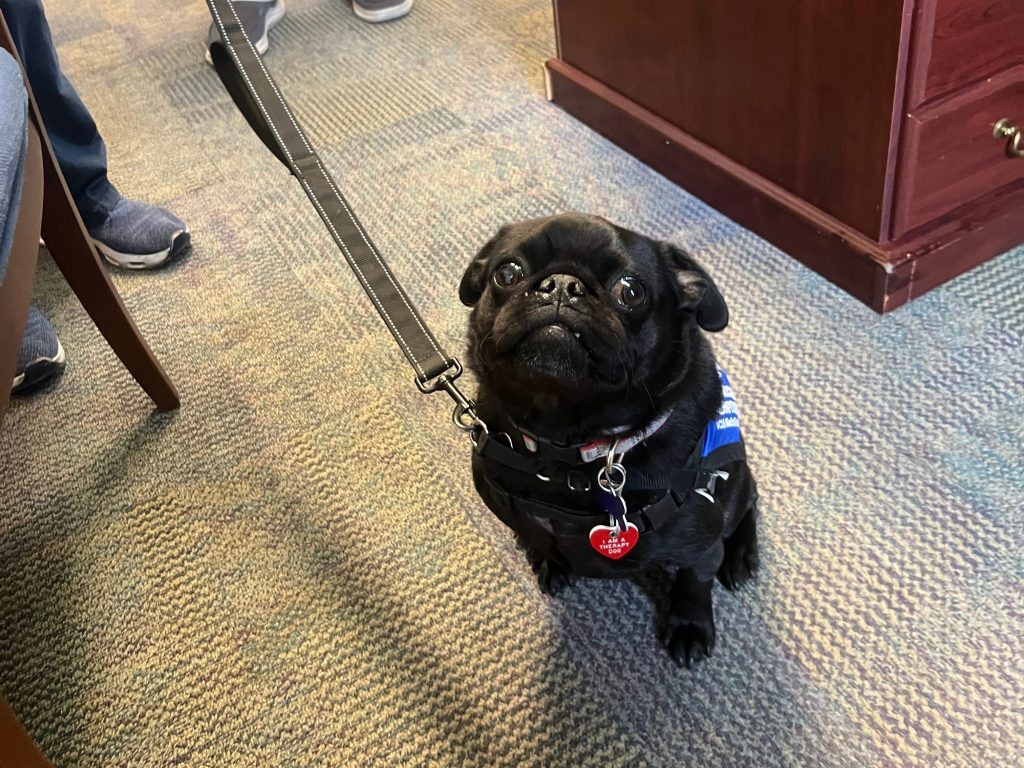
Nearing the end of the interview with Gee, a handler and their therapy dog – Pat and Gus respectively, walked into the room. It was firsthand proof of how a dog is able to brighten up a room, as you could feel the energy in the room instantly shift as Gus came prancing in sharing his unconditional love.
“He can get a whole bunch of smiles out of people even in some of the worst times,” Pat said.
For many involved in the program, those moments are what keep them coming back.
Handlers often describe themselves as secondary to the dogs, modestly saying they are there to simply guide the visit. According to Gee’s research, this is true.
“The dogs are the stars of the show,” Gee said.

